Ehsan Samei Official Transcript
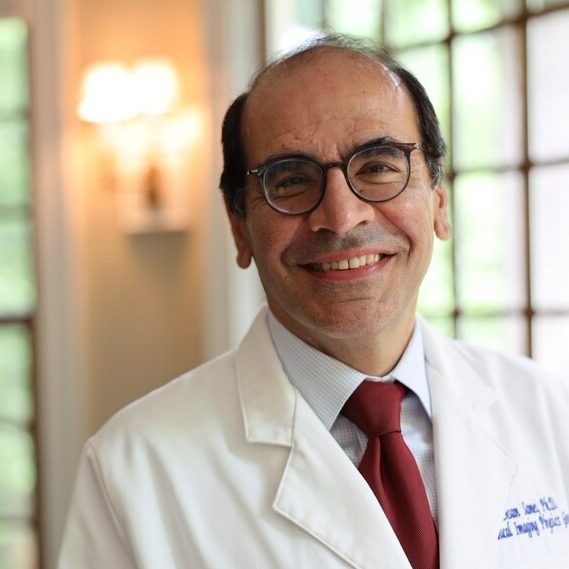
Chris St. John – 00:00:02: Welcome to Frame by Frame: Rethink Imaging, a podcast by Imalogix. Here, we explore the intricate world of medical imaging, aiming to dissect the field and inspire both professionals and curious minds alike. I’m your host, Chris St. John. Welcome back to Frame by Frame: Rethink Imaging. Last week, we were talking with Dr. Tom Griglock, and we wrapped up that conversation talking about the differences in between science and medicine, which for me as a former restaurant guy, was something I had never really paid too much attention to. I always saw them as entirely intertwined and linked. So today on Frame by Frame: Rethink Imaging, we are honored to have Dr. Ehsan Samei as our guest. Dr. Samei is the Reed and Martha Rice Distinguished Professor of Radiology at Duke University, where he also holds appointments in medical physics, biomedical engineering, physics and electrical, and computing engineering. As the Chief Imaging Physicist for the Duke University Health System and the Director of the Carl E. Ravin Advanced Imaging Laboratories and the Center for Virtual Imaging Trials, he has played a pivotal role in advancing the field of medical imaging through both research and clinical practice. Dr. Samei’s distinguished career includes over 1,400 scientific publications and numerous awards, including fellowships from five major professional organizations and the title of Distinguished Investigator from the Academy of Radiology Research. His work focuses on enhancing image quality, safety metrics, and virtual clinical trials, bridging the gap between scientific innovation and clinical application. With a strong background in x-ray imaging, and AI integration, Dr. Samei’s insights are shaping the future of medical imaging, making him a leading voice in the ongoing evolution of the field. Welcome to the show, Dr. Samei.
Ehsan Samei – 00:01:59: Great to be with you, Chris.
Chris St. John – 00:02:01: Yeah, thank you so much for being here. That was quite the introduction. Thank you for sitting through it.
Ehsan Samei – 00:02:06: Thank you. Those are part of the vernacular that goes around my professional career, but there is more to it. And I’d like to talk to you more about what some of those things mean.
Chris St. John – 00:02:16: Yeah, absolutely. For me, most of what I just read lacks a lot of context. And so I’m excited to figure out what’s going on. But before we dive into this, just so our listeners and I can get to know a little bit more about you, given your impressive background in imaging technology, can you talk about a moment or a project in your career or in your academic life that kind of sparked this interest in medical imaging and that you kind of hold on to?
Ehsan Samei – 00:02:45: Well, that’s sort of probably the most monumental episode in my professional career was how I end up into the field of medical imaging. I was a physicist. I was trained as a physicist. And I like the purity of physics in which you can ascertain the deep realities of nature. And then I realized as beautiful as those things are, it’s important that our science, our insights, our intelligence would have a human benefit, more direct human benefit. So I actually was very tempted to pursue medicine after I finished my physics. And I stumbled across a book in a library when such things existed. Yeah, so I ended up actually being in a library and looking through the shelves, and I find this book about medical imaging, like medical and imaging, medicine and physics, how they too relate to one another. I thought they belong to two different worlds. And I read that book overnight. I was mesmerized by that book, and the rest is history, as people say. I was just so mesmerized that I could practice that sense of intelligence and purity that attracted me to physics in the first place, but practice it in such a way that could have some direct human benefit.
Chris St. John – 00:04:12: Yeah.
Ehsan Samei – 00:04:13: The beauty of combining these two elements, this rigor of scientific pursuit and the relevance of clinical practice is what brought me to this field, what has kept me in this field, keeps me going in this field.
Chris St. John – 00:04:28: Yeah. And so for me, as I’m trying to figure this out, what are kind of the differences between this purity of physics and the nuance of clinical practice in medicine? And where are you kind of finding the intersection?
Ehsan Samei – 00:04:42: Yeah. The intersection is that, you know, in physics in particular, in all core sciences, but in physics in particular, there is a sense of certainty that, for the lack of a better word, some degree of hygiene, in that things are very clear-cut. Of course, when you go to quantum physics and things become more muddily, if you will, but even in the muddliness, there is some certainty and confidence in what we’re pursuing. When it comes to patient care, there is a lot that we don’t know. And as a result, we talk about the practice of medicine or art of medicine, implying there is some degree of cushioniness. And you wonder why that is. Is that because medicine is not precise or medicine is not as good as physics? I don’t think that’s true. I think we practice as much certainty as we have confidence for. In other words, if we are posed with a question that you don’t quite know the parameters around the question, you hedge your way to an answer. And in fact, most of life is that. You’re hedging your way to an answer. And in medicine, you do it in a very meaningful way, in a very ethical way, in a way that because whatever decisions or actions you’re taking would have an impact on other human beings, right? So, that’s the sort of dichotomy, the paradox of two different ways of approaching reality. One is a way of sort of assuming everything is clear cut. And the other one in which you sort of surf your way through life or hedging your way through life because you just don’t know all the nuances, all the details, all the minutia of what really matters and what’s important. So medical physics and medical imaging is in space in which these two worlds touch one another. And where I feel like some sort of a dual personality of the medical physicist comes to play. You need to practice your rigor of scientific mindset, but you need to do it in a relevant way, in a practical way that makes sense in the context in which you don’t know all the answers.
Chris St. John – 00:06:56: Yeah. You know, that’s great. It’s complicated. It’s so much to chew on from the beginning, which is cool, which is why it’s exciting to me to hear about this and learn about this. But immediately what comes up for me, and to be totally transparent with the listeners, this is not my first time talking with Dr. Samei. We have interacted in the past. But to go back to our previous conversation, one of the things we were talking about is the nuance of numbers and data in these fields, right? And so especially as I’m thinking about the difference between physics and medicine, between science and medicine, between science and clinical practice, like the role of numbers and data and our interpretation of it seems to be huge, right?
Ehsan Samei – 00:07:38: Right.
Chris St. John – 00:07:38: And so, you know, how do we go about approaching that as we’re gathering new data, as we’re finding out new things? Like, how do you think about this?
Ehsan Samei – 00:07:46: Yeah, so that’s a very good question. And sort of very natural question, given what we were just talking about. So when you think about medicine and practice of medicine is a doctor visiting a patient at home, thinking about like early 20th century movies, you see, you know, the patient is sick, a doctor comes and knocks on the door, comes in and take care of it, doctor is not a scientist. It’s really a caretaker, care provider.
Chris St. John – 00:08:16: Right, of course.
Ehsan Samei – 00:08:17: Provide assurance to the patient, would provide assurance to the family, comfort them, give them context, give them also some stuff that proven to be effective in that person’s private practice. But it’s not a lot of data there.
Chris St. John – 00:08:33: No.
Ehsan Samei – 00:08:33: It’s like, try this medicine, see what goes on. I will check on you tomorrow type of thing, right?
Chris St. John – 00:08:38: Right.
Ehsan Samei – 00:08:38: That is what medicine has been for majority of the human existence. We have realized, though, that there are generalizable knowledge that we can consolidate. And that medicine becomes much more of a scientific discipline. And in that trajectory, then we need to have a way of aggregating our insights. In such a way that what we learn from one patient can be combined with what we learn from another patient and the patient next to that and next to that. And that creates some degree of generalizable knowledge. So when you get aggregating knowledge or insight, how do we aggregate insight? You cannot aggregate comments from patients or comments from physicians. You aggregate data.
Chris St. John – 00:09:22: Right.
Ehsan Samei – 00:09:23: Where data comes in is an effort of aggregating our intelligence in a medical practice. And because what this patient has is not totally unique, is unique to that patient. And that’s, by the way, that uniqueness and practicing of that uniqueness is what we call patient-centered care. So I want to give you the medicine that is good for you. But at the same time, you are not a different species than other humans that are out there. And it’s very likely that what you’re afflicted by has affected somebody else too that has proven to be treatable if you apply this sort of technological innovation to it. Right?
Chris St. John – 00:10:02: Right.
Ehsan Samei – 00:10:02: If you know 20 people like you somewhere else had that condition and get treated, don’t you want to be benefited by that insight?
Chris St. John – 00:10:10: Right? Absolutely. And I’m already like, oh, wait, well, hang on. There’s already too much nuance going on, right?
Ehsan Samei – 00:10:16: Right.
Chris St. John – 00:10:16: Something like, you know, as a kid, I had a bad reaction to penicillin, right? It’s like, I could absolutely have been the one in a sample size of 20 where you think like, oh, here’s the medication to solve this problem. And then immediately it’s like, nope, actually not. This is horrible for this specific body.
Ehsan Samei – 00:10:33: Right. So in some ways, actually, again, that’s the study. I’m just throwing too many paradoxes in this space. In some ways, you are very unique in that you have this specific reaction to penicillin, but it’s very likely you are not the only one that have, that reaction to penicillin. So if I can find out some other ones, that have a specific reaction to penicillin, then I can still create a generalizable knowledge about this particular reaction to penicillin, right?
Chris St. John – 00:10:59: Right.
Ehsan Samei – 00:11:00: So how would I sort that out? Well, by data.
Chris St. John – 00:11:03: Right.
Ehsan Samei – 00:11:03: So I need to aggregate data, I need to understand data, I need to understand the variability of the data, I need to understand what is unique about you that puts you and that weird patient in the same cohort, right?
Chris St. John – 00:11:13: Yeah.
Ehsan Samei – 00:11:14: Well, I can then make sense of it. But then, I mean, one other thing I would say that that’s become the problem because that data way of approaching what we need is not really in some ways not native to medicine. In the medicine movie that we just watched. Right? It is somewhat far, it’s more physics-y. It sounds like you’re collecting data from elementary particles to figure out what is what. Has that kind of quality to it.
Chris St. John – 00:11:41: Yeah.
Ehsan Samei – 00:11:42: So that’s what I mean. There is this scientific rigor zone in which you need to tap into, you know, to be able to practice medicine in the 21st century.
Chris St. John – 00:11:50: Yeah. So how do you even begin to start approaching, thinking, and categorizing this data, especially in medical imaging specifically, right? How would you think about trying to sort through all of this?
Ehsan Samei – 00:12:06: Right. So now that we got to a point that we need to bring that rigor of science into medicine more wholeheartedly, making what we call medicine evidence-based, that transition can happen through data. Then the question becomes, what data? What are we talking about? Ideally, what you want is the data that proves a particular innovation effective or not effective.
Chris St. John – 00:12:31: Right.
Ehsan Samei – 00:12:31: So in other words, you need to have the patients enrolled into some sort of a study in which we tried certain medication and certain other medications and compare the results downstream, whether the patient medication was effective or not. What we call clinical trial.
Chris St. John – 00:12:46: Right.
Ehsan Samei – 00:12:47: And there is a lot of medicine is done through clinical trials. The beauty of clinical trials is that you know the outcome.
Chris St. John – 00:12:53: Right.
Ehsan Samei – 00:12:54: For a majority of the cases, we just don’t know the outcome.
Chris St. John – 00:12:56: Yeah.
Ehsan Samei – 00:12:57: In fact, in clinical practice, you never know the outcome. Retrospectively, you can say, go back and say, oh, Chris, if you have given you that medicine two years ago, would that be much better?
Chris St. John – 00:13:06: Right.
Ehsan Samei – 00:13:07: We know that, but we know now.
Chris St. John – 00:13:08: Yeah.
Ehsan Samei – 00:13:09: So as a result, you can think about practice of medicine is extrapolating from what we know from the past to the future. That extrapolation requires some degree of faith. It requires some degree of what we call surrogates, surrogates of quality, surrogates of effectiveness. So I don’t know that this particular medical imaging that we performed on you has adequate quality or not for what we need to see. But we can measure certain attributes of that medical image to figure out what’s the likelihood. Of that medical image to be effective.
Chris St. John – 00:13:47: Right.
Ehsan Samei – 00:13:48: Likelihood of being effective. I’m underlying that, right?
Chris St. John – 00:13:52: Right.
Ehsan Samei – 00:13:53: So I am essentially don’t know 100% that what we are doing right now to you as a patient, to me as a patient is effective, but the best that we can do, come up with the best scientifically judged. Surrogate that what we do might be good.
Chris St. John – 00:14:11: Yeah.
Ehsan Samei – 00:14:11: The same way, if you’re a restaurant chef, you’re not sure that the customer would like the food, but you extrapolate from your knowledge of what you have done in the past. You know, this person tells you that they don’t like stuff that are sour or sweet or whatever. You make some degree of predictive decision. He’s okay.
Chris St. John – 00:14:32: Yeah.
Ehsan Samei – 00:14:32: I think that’s going to work and you hope for the best.
Chris St. John – 00:14:35: Oh, absolutely. You know, our listeners, I used to own a restaurant. I was a chef. I was a bartender. I kind of did it all. It’s the exact same situation when you’re standing behind the bar and someone comes up to you and they’re just like. Oh, I don’t know what I want to drink. Can you make me something?
Ehsan Samei – 00:14:50: Right.
Chris St. John – 00:14:50: And it’s like, okay, well, like, I need a little bit of data. I need a little bit of background here, right? It’s like, do you typically enjoy bitter, high-proof cocktails or something sweeter and a little more low proof? And then as I like, ask a couple of questions, it’s like, oh, yeah, I can make you a cocktail that with some level of certainty, I feel like you will enjoy. But at the same time, I’ve done this 100 times, and they don’t always love it. You know, like you ask all the right questions, you get all the right information. But that doesn’t necessarily mean that your result is going to be effective or correct.
Ehsan Samei – 00:15:25: So, I mean, think about in that sort of using that as an example, you are guessing. And if you are a good professional in what you do, you guess well. You know, if four times you do this, three of the times people throw your drink at you, you realize you’re not guessing well. But the majority of the time, and I suspect the majority of the time that was the case for you, people say, oh, yeah, that’s close to that, or that’s perfect. Hit the spot. Okay.
Chris St. John – 00:15:53: Right.
Ehsan Samei – 00:15:53: So in the same way, I would say in the practice of medicine, we are in the guessing game. We’re guessing. We’re guessing all the time. There are highly educated guests. There are highly sophisticated guests, but guests nonetheless, right?
Chris St. John – 00:16:04: Right.
Ehsan Samei – 00:16:05: So how do we guess? By going to medical school, going to fellowship and residency, residency and practicing and reading the articles. And then the patient shows up, which is not in any of those articles that we have read.
Chris St. John – 00:16:18: Right.
Ehsan Samei – 00:16:19: But it’s close. We say, oh, this is similar to that. Therefore, I’m going to make an educated guess and I’m going to pursue it this way. I’ll be 100% sure in that guessing. The answer is no.
Chris St. John – 00:16:30: Right. Of course.
Ehsan Samei – 00:16:31: If that was the case, you don’t have to go to the doctor. You just give your symptoms to an algorithm and the algorithm would give you the answer. You don’t need to go see a doctor. You say, fill in this form and here is it, and push the button and here’s a prescription. We are not there. Why not? Because we cannot guess well.
Chris St. John – 00:16:51: Well, I don’t know. WebMD has diagnosed me with cancer like 10 times over at this point.
Ehsan Samei – 00:16:56: Right.
Chris St. John – 00:16:57: Every time I’m Googling my symptoms, it seems to be something horrific and deadly when diagnosed by the algorithm.
Ehsan Samei – 00:17:02: Right. And the fact that maybe you can say, well, we are moving in that direction. Definitely, we are advancing in that direction.
Chris St. John – 00:17:08: Yeah.
Ehsan Samei – 00:17:08: For sure. But still, there is a lot that we don’t know. And for that, we rely primarily on human intelligence.
Chris St. John – 00:17:15: Right.
Ehsan Samei – 00:17:16: And I want to believe that human intelligence is going to be with us for quite some time still moving forward. Therefore, the question then becomes how we can assist human intelligence.
Chris St. John – 00:17:29: Yeah.
Ehsan Samei – 00:17:30: With this additional data-informed insight. So rely fully on human mind, the rather we can provide an assistance to the human mind, right?
Chris St. John – 00:17:41: Yeah.
Ehsan Samei – 00:17:41: In the same way, in the past, we walked everywhere and then we end up getting on the horse and then we started making cars and we’re getting the cars.
Chris St. John – 00:17:51: Right.
Ehsan Samei – 00:17:51: We are still transporting ourselves.
Chris St. John – 00:17:54: Yeah.
Ehsan Samei – 00:17:55: But we are doing it in an assisted fashion, in a very sophisticated assisted fashion.
Chris St. John – 00:18:00: Yeah. So now that we’ve kind of talked more broadly about science and medicine kind of categorically, can we like dive in a bit more into medical imaging?
Ehsan Samei – 00:18:10: Okay.
Chris St. John – 00:18:11: So I guess, and maybe this is too big of a question, but what are the types of data that are critical in assessing the success of medical imaging and treatments, right? Like what kind of numbers, what kind of data are we looking for?
Ehsan Samei – 00:18:25: So in the guessing game that medicine is all about, medical imaging introduced over a hundred years ago became a disruptive innovation that really advanced that domain dramatically in a sense that now we can peep into people’s body and figure out what’s going on inside, right? That’s what medical imaging is.
Chris St. John – 00:18:46: You’re saying that’s destructive?
Ehsan Samei – 00:18:47: In a very disruptive.
Chris St. John – 00:18:49: Oh, disruptive. Okay. That makes way more sense.
Ehsan Samei – 00:18:52: No, no, no, no. In a disruptive way, it disrupts the practice of medicine, so to speak.
Chris St. John – 00:18:57: Right. Yeah.
Ehsan Samei – 00:18:58: I mean, a few decades ago, you would do what so-called exploratory surgery. They open up the patient to just figure out what’s going on and then close the patient up. So we don’t have to do that. We can essentially open the patient up virtually by true medical imaging.
Chris St. John – 00:19:11: Right.
Ehsan Samei – 00:19:11: So medical imaging has provided a significant way of peeping into people’s bodies and try to discern what’s going on inside, which otherwise you would not be able to see. I mean, medical imaging just continue to accelerate and does amazing things. It shows up things to us that otherwise we cannot see. Even if you open the patient, you cannot see. But just like any other innovation or intervention in medicine, we don’t know perfectly. It’s not exact. It’s not perfect. It’s approximate.
Chris St. John – 00:19:42: Right.
Ehsan Samei – 00:19:42: Just like everything else we have access to. And if you don’t believe me, think about, for example, if you have a condition, you have a brain condition, you get a CT exam. You get an MR exam, you might get an ultrasound exam or a nuclear exam. These are all different ways of taking pictures of the body. Why one of them would not be enough? Because each one shows a dimension that the other one doesn’t.
Chris St. John – 00:20:04: Right.
Ehsan Samei – 00:20:04: In other words, each one is incomplete in a certain way. That’s why different medical imaging modalities. Sometimes needed because they provide complementary information. Okay. But the fact, the complementarity, that’s my point, the complementarity of different imaging modalities is a proof that medical imaging is not perfect.
Chris St. John – 00:20:25: Right.
Ehsan Samei – 00:20:26: So if it’s not perfect, how imperfect is it? That’s the question to ask. So if it was perfect, then I don’t need to do any assessment of its quality. It’s fine. Its quality is perfectly fine. But because imperfect, I need to have a measure of its imperfection. And that would give me a measure of quality that I can practice through medical imaging.
Chris St. John – 00:20:48: Yeah.
Ehsan Samei – 00:20:48: Right. So going back to how we measure the quality of medical images, essentially we’re trying to assess the measure of its perfection or imperfection, are two sides of the same coin. So the question would become, what is that measure? I would say the measure is that how close that image represents the reality that it’s trying to represent. So if you have a tumor, well, how good does it show me the tumor? How good is the image to discern whether the tumor exists or does not exist? Or if his tumor has a certain size or he has been growing by a certain rate, how good is the image to tell me how fast his tumor is growing or regressing? That becomes the essence of the goodness of that medical image.
Chris St. John – 00:21:36: What do you mean by that?
Ehsan Samei – 00:21:37: So that goodness, therefore, by the way, I’m happy to unpack any of the words that I’m using here. That goodness needs to be task specific.
Chris St. John – 00:21:46: Right.
Ehsan Samei – 00:21:47: So let me tell you what I mean by that. So when I show you a picture of my, you know, vacation that I took last week, you look at the image, you say, oh, this is a great picture. It’s wonderful. That is a task generic statement.
Chris St. John – 00:22:00: Right.
Ehsan Samei – 00:22:00: You’re making, I would say, good in what terms? In terms of what?
Chris St. John – 00:22:04: Right.
Ehsan Samei – 00:22:05: In medicine, you always need to ask in terms of what? You can say, well, this image looks great. Great for what? I’m not interested to impress people with your image. I want to see if there is a tumor, a tumor is showing or doesn’t show. Right?So that’s what I mean by task specific. It’s for a purpose.
Chris St. John – 00:22:26: Right.
Ehsan Samei – 00:22:27: For the purpose at hand, does this image do what it’s supposed to do?
Chris St. John – 00:22:32: Right.
Ehsan Samei – 00:22:32: So what we have done, I have done through most of my professional career is that how can I get a medical image, Chris, and guess my way through it. These are all guessing. Science is all about guessing.
Chris St. John – 00:22:45 Right.
Ehsan Samei – 00:22:45: Guess my way through. How good is this scenery that I’m seeing to reflect what I need to see in that patient? What I need to see in the patient is the task.
Chris St. John – 00:22:57: Right.
Ehsan Samei – 00:22:57: So people use the term task specific image quality. That’s a fancy way of essentially saying, do I see what I need to see?
Chris St. John – 00:23:05: So I guess to keep building on this, then like the human element needs to come back into it again. Right?
Ehsan Samei – 00:23:11: Yeah.
Chris St. John – 00:23:12: So like in what way? Does our interpretation and the expertise of, you know, radiologists, academics, like what role does our interpretation play in applying data to imaging studies?
Ehsan Samei – 00:23:26: Right. So a good way of answering that question is the very word that you used, interpretation. We don’t talk about reading an image. We talk about interpreting an image. If I give you a poem and say, what is your interpretation of this poem? By using that term, I’m implying that there are different ways of interpreting that poem.
Chris St. John – 00:23:48: Right.
Ehsan Samei – 00:23:48: Right. So first of all, I was just going to emphasize the word interpretation implies certain degree of guessing work in the process.
Chris St. John – 00:23:55: Right.
Ehsan Samei – 00:23:56: So a human intelligence is needed to make that determination. The human intelligence needs to be aided by the data that the system would be providing, the image would be providing. And if medicine is all about reducing the uncertainties, making better guesses, if you will, if the medical image is able to provide us more concrete reflection of what is happening inside the body, then that human interpreter has more at his disposal or her disposal to make a better interpretation. You know, it’s like if I give you a text and say interpret it and the way the text itself is very poorly written, then your interpretation would go all over the place. But if the text is a more clearly written, then it’s more likely your interpretation is closer to what the reader intended.
Chris St. John – 00:24:49: Yeah.
Ehsan Samei – 00:24:50: In the same way, if my medical image is providing a more concrete data that is more reflective of the reality of the patient, the interpreter would have higher chance to be able to interpret it most accurately.
Chris St. John – 00:25:04: Right.
Ehsan Samei – 00:25:05: Does it make sense?
Chris St. John – 00:25:06: Yeah.
Ehsan Samei – 00:25:06: I have one other thought that just escaped my mind. I was just thinking about this. See, yeah, that’s what I wanted to say is this. So, you know, when you think about going back to one of the earlier discussions, what medicine is all about, medicine is about reducing uncertainty.
Chris St. John – 00:25:23: Yes.
Ehsan Samei – 00:25:23: In fact, expertise is about reducing uncertainty. If I have a problem with my plumbing in my house, there is some sort of weird things happening in my house or in my electrical system in my house, and I bring an expert electrician to come and fix this and give me an opinion. If the expert says this could be this or that or that or that. Like give me four or five options and cannot figure out which one is which, that expert, as far as I’m concerned, is useless.
Chris St. John – 00:25:51: Yeah.
Ehsan Samei – 00:25:52: Because you’re indicating as much as I already have those uncertainties. Your job as an expert is to reduce uncertainty, not to increase it.
Chris St. John – 00:26:00: So how do you balance the quantitative data with the qualitative insights in making decisions about patient care?
Ehsan Samei – 00:26:08: So when a doctor says, well, it could be this or that or that or this, it’s like, okay, how good are you? Really? Right? Of course, you don’t want to be wrong to give you the wrong thing. So accuracy is important. I’m not saying accuracy of interpretation is not important, but reducing uncertainty is equally important. In fact, that’s probably most likely thing that we need to have to practice medicine proficiently and well, reducing uncertainty. So you didn’t know many things before you saw the doctor, you’re more certain about your medical condition. So in the same way, if I am able to provide the human interpreter a little bit higher quality medical image that is quantified as being higher quality.
Chris St. John – 00:26:49: Right.
Ehsan Samei – 00:26:50: So they can be more certain in their interpretation, then patient will be better served.
Chris St. John – 00:26:55: I mean, it’s simple, but it kind of, that feels like a very effective way of thinking about it, especially for me. That’s like an easier way to think about something that has infinite nuance to it, I guess.
Ehsan Samei – 00:27:07: So the way I think about this, this is a good question, by the way, Chris. You’re asking brilliant questions.
Chris St. John – 00:27:12: Right.
Ehsan Samei – 00:27:12: I appreciate it. You asked me to think deeply about this thing. The way I frame this is that for the things that you do know, quantitate. For the things that you do not know, qualitative. That’s the best way of putting it, right?
Chris St. John – 00:27:28: Right.
Ehsan Samei – 00:27:28: I’ll give you another example. I love examples. Looking at the back of the package of the food, it says you have this much carbohydrates, this much fat, this much protein, and so much. They are very quantitative. So these are the things that we can quantitate. Is it useful to quantitate them? I would say yes. I love to see how much protein is in this package, how much fat and whatever. Does that mean that this tastes good?
Chris St. John – 00:27:50: No.
Ehsan Samei – 00:27:50: No. Taste is not quantitative.
Chris St. John – 00:27:53: Right.
Ehsan Samei – 00:27:54: Tasting to be qualitative.
Chris St. John – 00:27:55: Right. Yeah.
Ehsan Samei – 00:27:57: So here’s a good example. So quantitate the things that you do know, but don’t assume the stuff that you have quantitated and you do know is the end of the story.
Chris St. John – 00:28:08: Oh, absolutely. Like, I mean, to just like build on this example, like I think about, once again, former chef here, there’s going to be a lot of food references. But, you know, I think like thinking about something as simple as like, it will take X amount of time to boil this amount of water. Well, is the water salted? Well, where are you relative to sea level? Right. Like all of a sudden, something that you think you have like pretty succinct data on, once again, it just kind of goes out the window as soon as you start thinking more and more deeply about it.
Ehsan Samei – 00:28:38: Right. So as a result, you can think about that qualitative approach towards reality is the sauce, is the space that fills the gap. That’s what makes all the difference. Well, I mean, what I just said is actually the irony. We feel like when we quantitate, we feel like we got it. We understood, you know, we know what that person is all about because we have quantitated that thing. But in reality, there is more to that entity that we are after in the qualitative terms of that thing, right?
Chris St. John – 00:29:13: Yeah.
Ehsan Samei – 00:29:13: So in medicine, we quantitate. We measure the size of the tumors. We ask the question, you know, how much is tumor is growing and not growing? All of those are quantitative. I can measure the resolution of an image. I measure the noise of an image. These are all quantitative measures of how good that image is. Is that the end of the story? No. Does that mean that therefore I need to throw all the numbers out? They don’t mean anything? No, that’s not the case. I still like to have those how much sugar and carbohydrates in my package. I still need to have it. That doesn’t mean that those are meaningless. They’re very meaningful that how much sugar in that package for me. But that doesn’t mean that fully describes the reality of that thing. That’s where the human element comes in. Using that example again, right?
Chris St. John – 00:29:59: Right.
Ehsan Samei – 00:29:59: So physician needs to have all the quantitative, insight at his or her disposal, but should never assume that they got the final answer because that’s the arrogance of sort of assuming that you got it. And when you got, you have that arrogance, you go wrong.
Chris St. John – 00:30:16: Absolutely, and we’re also at this moment in time too, where at least from my perspective, it feels like the human element is not really taking a back seat yet, but as data analytics is becoming more advanced as we start using more and more of these AI tools, like how do you see the role of human judgment evolving with the application of all of this?
Ehsan Samei – 00:30:43: I think we will continue. I mean, there is no question that sort of data analytics, machine learning, artificial intelligence has been another disruptive technology at the human level for everything that we do as insightful and as impactful as they are.
Chris St. John – 00:31:02: Right.
Ehsan Samei – 00:31:03: I think they don’t have the final answer in the sense that, you know, many things are still unknown and uncertain. Like for example, people always think about, okay, we’re going to train all these algorithms and detect all the cancers that might be in the body and humans need to ever, ever, you know, diagnose them, whatever. But all the examples that they provide are for types of cancers that, for which we have many examples. There are thousands of rare diseases. We don’t have good examples. So for those examples, we don’t have enough data to be able to train an algorithm to figure out what is what.
Chris St. John – 00:31:39: Right.
Ehsan Samei – 00:31:39: So you can give me a hundred thousand cases of a disease. Sure. I can maybe do something. Give me 100. Do you really feel like I can train an algorithm to figure out how things are for a hundred cases? Good luck. For many cases, we don’t even have a hundred cases.
Chris St. John – 00:31:53: Right.
Ehsan Samei – 00:31:54: And then when it comes to interpretation, Chris, you don’t interpret only the image. You interpret everything associated with the patient and the context and everything around it. Like for example, when that doctor would go and visit the patient, would look at everything. They look at the color of the skin. They look at the, you know, physique of the patient. They look at the attitude of the patient. They look at the eyes of the supporters. All of that gets fused into that amazing brain of the artist physician who care for the person. They also provide medicine. Right?
Chris St. John – 00:32:28: Right.
Ehsan Samei – 00:32:28: Now all of that information can be fed into an algorithm and an algorithm can become that soft, nice artist physician to do that. But in order to do that, you need to first quantitate all of those elements in the same way this stuff and then be able to fit it into an algorithm and train it. So that we have years to go for this sort of contextual, integrative sort of machine learning that we actually practicing medicine. It’s not just about reading one image that you fit into an algorithm to say cancer, no cancer. It’s more than that. It’s about reading the entire chart, looking at the background, putting it into context. Right?
Chris St. John – 00:33:08: Right.
Ehsan Samei – 00:33:08: So in that space in which there is a lot of unknowns, that’s where the human interpretive intelligence insight would come in. Would additional quantitative analytics help the patient, help the physician to make the interpretation? Yes, of course. In the same way, if I want to go to the grocery store, I’m aided by my car. I don’t have to walk half an hour. I can just drive for two minutes. So I can go faster, but I still need to go to the grocery store. So in other words, many uncertainties that still exist. So that’s, we need to essentially bring this quantitative and qualitative stuff, fuse them together for the betterment of the patient.
Chris St. John – 00:33:49: Yeah. So, you know, I feel like that touches a bunch on like diagnostic in AI and stuff. But like there’s also we are able to just process more data and learn so much. But like what are the data points or metrics that you consider indicative of like success in medical imaging? Right. Like what are we actually looking at when we’re talking about the success of medical imaging?
Ehsan Samei – 00:34:17: Well, I mean, success is essentially to be able to come up with a definitive diagnostic imaging. Is a definite diagnosis of what’s going on with the patient. In the context that we use medical imaging for tracking, that means you already know the disease or you’re treating the patient. Then you are looking at the progression or regression of the disease. Again, diagnostic imaging is used for that as well. Diagnostic imaging is also used, well, for planning purposes. So for example, you need to go to a surgery. So we need to figure out exactly what angle we need to go in and exactly how we navigate to the disease site. All of that stuff is also part of the medical imaging value that is provided through the technology.
Chris St. John – 00:35:01: Right.
Ehsan Samei – 00:35:02: So success would be being able to do those things effectively. At the end of the day, medicine is about reducing human suffering. All right?
Chris St. John – 00:35:10: Right.
Ehsan Samei – 00:35:10: But again, as I was saying, is that you practice now for a benefit that you expect downstream. It’s always perspective. It’s never retrospective. You learn from retrospective data so you can practice prospectively.
Chris St. John – 00:35:26: Right.
Ehsan Samei – 00:35:26: And that’s become the dilemma. So that’s what I mean by guessing work. You never know. You have not tasted the food yet. And you think about it this way, again, using the restaurant analogy, you rarely use the same recipe. The recipes are always slightly so very different. That’s the essence of patient-centered care. Each recipe is so slightly different and sometimes dramatically different. And we don’t know exactly if that difference is going to make a difference or not.
Chris St. John – 00:35:54: Sorry, just hold on to it on that for a second.
Ehsan Samei – 00:35:56: That’s fine.
Chris St. John – 00:35:57: It’s a great analogy. I really appreciate food-centric stuff. Yeah. I mean, you know, it makes me think about just like putting out dishes in a restaurant, right? Like different things are seasoned to different levels. And every time you pick up an identical dish that has the same amount of food by weight, there’s still variations and stuff, right? There’s like variations in the thickness of the meat that’s going to affect like how thoroughly you season it, how long it takes to cook, like all of these little details.
Ehsan Samei – 00:36:23: I mean, that’s what, sorry to interrupt you. That’s what also makes each medical image different. You know, Chris, even if you take the same patient, if you take me to the hospital and image me three times, you don’t see the exact same image. It’s slightly different every time.
Chris St. John – 00:36:38: Right.
Ehsan Samei – 00:36:39: So how would you make sense of this variability, right? I mean, let alone now, if you take me to three different hospitals and get me three different images, the variability is now increasing. And now take three different hospitals and three different physicians interpreting those images. You’re increasing the variability yet one more time, right?
Chris St. John – 00:36:58: Yeah.
Ehsan Samei – 00:36:58: So the question is that how do we gauge that variability? At the end of the day, those images are not about the hospital. It’s about me, right?
Chris St. John – 00:37:07: Yeah.
Ehsan Samei – 00:37:08: You’re not diagnosing the hospital. You’re diagnosing me. So it needs to be about me. But the fact that the images are different and the interpretations are different, that tells me there is variability in this space.
Chris St. John – 00:37:18: And how do we reduce it?
Ehsan Samei – 00:37:19: So how do I know, talking about quality of medicine, how do I know, for example, I am a Duke University.
Chris St. John – 00:37:25: Right.
Ehsan Samei – 00:37:26: Is a Duke a good hospital? Yeah. It’s like one of the top 10 hospitals.
Chris St. John – 00:37:30: Right.
Ehsan Samei – 00:37:30: How much is better than another hospital? Is it better than five years ago? How do we quantify that? Do we have numbers? No, we don’t. A lot of those numbers are just because people think that, you know, we are good. But my point simply is that if we are seeking excellence in medicine, we need to have a way to quantify it. And if you’re seeking excellence in imaging, we need to have a way to quantify.
Chris St. John – 00:37:54: Yeah.
Ehsan Samei – 00:37:55: An excellence in imaging, one of the things I want to point out is that a lot of times we are so eager to measure things, Chris. Especially in the context of medical imaging, our primary measurant has been radiation dose. How much are we dosing the patient in the process of acquiring an image? But patients don’t go to hospital to get dosed. People, patients go to hospital to get imaged. So what matters, what quality worth measuring for the care of the individual is that what is the quality that was rendered in that imaging practice? Yes, keep track of the dose too to make sure he’s low enough. But what matters the most is the quality. It’s like you’re trying to judge, sorry, I’m using the restaurant analogy probably too much.
Chris St. John – 00:38:39: No, we’re going to stick with the restaurant analogy for this entire show. So, do not worry about it.
Ehsan Samei – 00:38:44: Right. If you think about for a second, if the only metric of quality for restaurants is the price of food, I mean, that maybe tells you something. I’m not saying it doesn’t tell you anything, but it’s a very poor indicator of quality of the restaurant.
Chris St. John – 00:38:58: Oh, it tells me, I mean, it tells me nothing. I can get an amazing taco, for $2 on a roadside stand and it’s going to be one of the best things I’ve ever eaten. And then I’m going to walk through the airport where I’m being overcharged and I’m going to pay $40 for a fried chicken sandwich, which is dry and old on a stale bun. Right? Like there is no connection there.
Ehsan Samei – 00:39:18: There is no, I mean, medical imaging right now, the primary factor that has been considered is dose, which is equivalent to the price of the food. Right? And I feel like that’s not the point. If the purpose of feeding people, feed them.
Chris St. John – 00:39:33: Right.
Ehsan Samei – 00:39:33: What is the quality of the feeding that you’re doing?
Chris St. John – 00:39:36: Yeah, absolutely. I mean, you know, I know image quality is where you spend a lot of your time and your energy these days.
Ehsan Samei – 00:39:42: Right. So that’s why I think I can go in full circle here. Now, do you see now how quantitative approach to medicine actually is important is needed. It’s not because physicists say so because medicine says so, because we want to generalize across those insights that I mentioned earlier. The only way to do that is through numbers. Science is done through numbers. Right?
Chris St. John – 00:40:05: Right.
Ehsan Samei – 00:40:06: And that quantitative approach towards practice of medicine is crucial and important.
Chris St. John – 00:40:11: Yeah.
Ehsan Samei – 00:40:11: But it’s not enough. It’s never enough. You know, you have to bring the human qualitative element in there because we don’t know everything. Yeah, I remember I have one of my colleague physicians used to come to me as a physicist and say, Ehsan, I already know the answer, but can you put numbers around it for me, please? It’s like, that’s funny, but to some extent it speaks the truth.
Chris St. John – 00:40:34: It’s depressing is what it is. I mean, I’m laughing, but it’s not funny.
Ehsan Samei – 00:40:39: It’s like coming to you and saying, no, Chris, I know this food is really bad. Can you tell me why?
Chris St. John – 00:40:43: Yeah. Well, honestly, we are starting to get to the point where this is about our time. And so I just to kind of go off on a tangent for one moment before we wrap up. One of the things that Tom and I were talking last week about was, you know, the number of people in this field and getting more bodies into this field in order to help it continue to move forward and remove some of these roadblocks by just having a volume of people involved. And you having mentored over 140 trainees and led significant research initiatives, what advice would you give to young professionals or potential students aspiring to either get into the field or make an impact in medical imaging and radiology?
Ehsan Samei – 00:41:27: So I think I would say in this field, as well as in honestly any other field of intelligence, human intelligence, we ought to be backward informed and forward progressive. In other words, a lot of times we just lean into the way we have done things in the past. I think we are in a different place in terms of how the quantitative and qualitative should merge, how the two needs to be advancing medicine forward. They’re both needed. You know, Chris, I am part of another movement in which we can have yet another podcast on that topic itself, what I call humanity of medicine. In the same way that medicine becomes more quantitative and advanced and analytical, which you should, because there is a lot of insight to be gained. The question many physicians ask themselves is that, how can we be more human in the practice of medicine? Because at the end of the day, we are in the vocation of being healers. We are not healing machines. We are healing real body and souls all together, right?
Chris St. John – 00:42:29: Yeah.
Ehsan Samei – 00:42:29: At this juncture is 2024. We are moving forward. It’s just driving a car. You have a back view mirror that shows you the back, but that’s only the back. We need to be driving forward. We have a significant larger windshield, right? A lot of us are very backward oriented. I feel like a lot of us in our practice of medicine, we perpetually looking at the back view mirror while the really the purpose of this car is to move forward. I think we need to have a much more, ironically, as much as we have broad machine learning and AI into our space, that by itself, ironically has emphasized how much we also need to embrace our humanity, not our own humanity. But also, humanity of the individuals that we care for, right? At the end of the day, when you care for an individual, you’re not caring again for an algorithm. You’re caring for another person just like you with the same level of dignity and autonomy and agency and all of that. So you need to somehow include that organic mindfulness as you’re bringing the analytical, mathematical insight into the practice. So we need to have more people that are attuned to both of these domains and ask critical questions of how we can have a more… Intelligent fusion of these two domains. Right now, if you ask me if I have an intelligent fusion, I don’t. I’m haphazardly going through this. The fact that people are addicted to their phones or they get input from the computer, they don’t know, they’re trusted, not trusted. These are all sort of, I feel like, reflective of the lack of literacy in the way that human and machine need to be worked together in a seamless fashion. And in some ways, I say one more thing here, sorry, I’m talking too much here. It’s not so much different from working with another colleague, right? If you bring five people into a room and say, let’s make a decision together, a committee work, it’s no trivial task because we come with different universes, different backgrounds, different parents, different mindset, different convictions, different faith, different everything, right? So if you bring a machine and a human to get into a room and say, make a decision, you have to figure out a way to fuse those two different types of intelligence. So we have done it in the context of, humanity, why can’t we do it in the concept of human and machine interactions?
Chris St. John – 00:44:56: I think that feels like a very good and natural place to wrap things up today. Dr. Samei, thank you so much for being on today. It’s been delightful having you. Once again, I think we’re going to have to have you back a couple of times, if that’s all right by you.
Ehsan Samei – 00:45:10: And going back to your first question, I think these are the things that we need to be mindful of, we need to include, incorporate into our medical education, we need to include in medical physics education, we need to include in the way we practice medicine, in the way we position medicine, in the way we innovate medicine, in the company work that we do, in the university academic work that we do.
Chris St. John – 00:45:31: Yeah, absolutely.
Ehsan Samei – 00:45:32: Sure, I’d love to. This was a great conversation.
Chris St. John – 00:45:37: Frame by Frame: Rethink Imaging is brought to you by Imalogix. Here, you’ll find engaging interviews with thought leaders, experts, and patients, sharing stories that showcase the transformative power of medical imaging. To discover how Imalogix is rethinking imaging in healthcare, visit imalogix.com. Be sure to subscribe to Frame by Frame: Rethink Imaging on Apple Podcasts, Spotify, or wherever you listen. And from all of us here at Imalogix, thanks for tuning in.